Value Creator Framework (Part 1 of 2)
This is part 1 of a 2 part series, see part 2 here.
I have not always sought to be a value creator. Only in the second half of my professional career did I realize that all work-related activities are about value creation.
I came to this realization, through a series of people, pouring value into my life. Upon reflection, I came to the conclusion, that I should do the same. I was not prepared for the result. It has been amazing to see how creating value in my relationships, both personal and professional, has led to higher heights. I have achieved more than I would have thought possible, but I believe it is because I have become a value creator, myself.
So, I have dedicated the rest of my professional life, to teaching others, to do the same. Value creation is a way of life, once you understand it, you will want to repeat it over and over again. It will become a large part of your identity and people will notice and you will attract other value creators.
This framework is intended to help others become value creators. It is broken into two parts, Inputs and Outputs. The inputs, as the name implies are things a value creator must possess, before they can produce the outputs (value). As you will see, the concepts build on one another and you cannot reach your fullest potential, as a value creator, until you assess and improve all aspects.
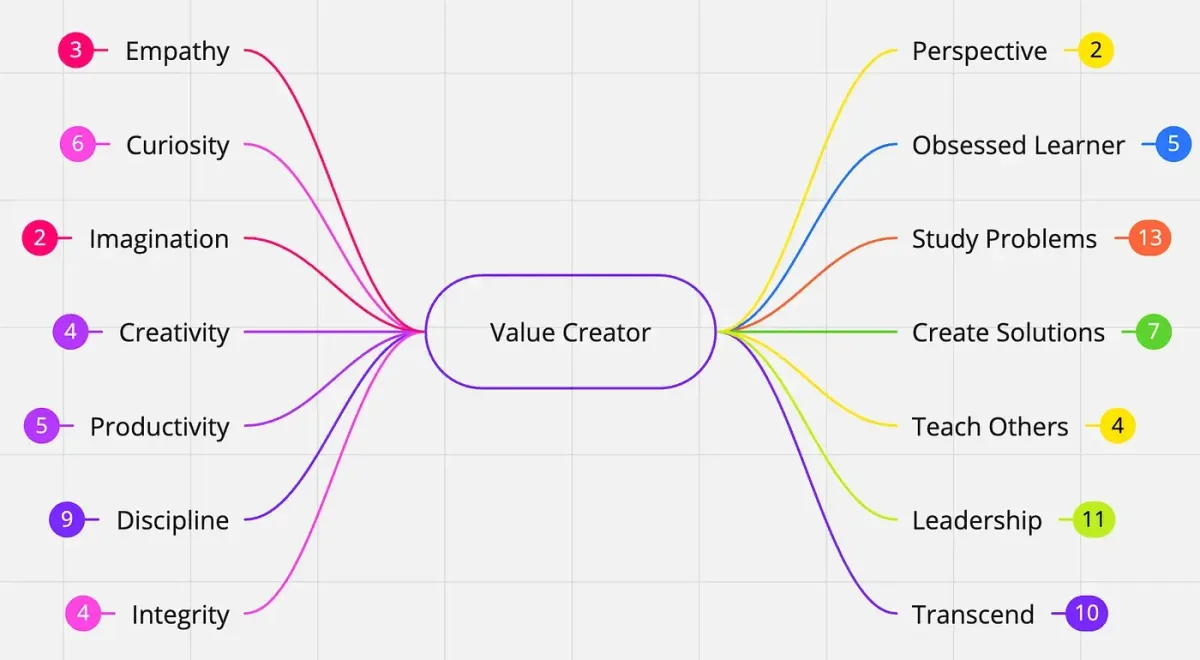
An overview of the framework is provided below. You can see further details and play with it, here.
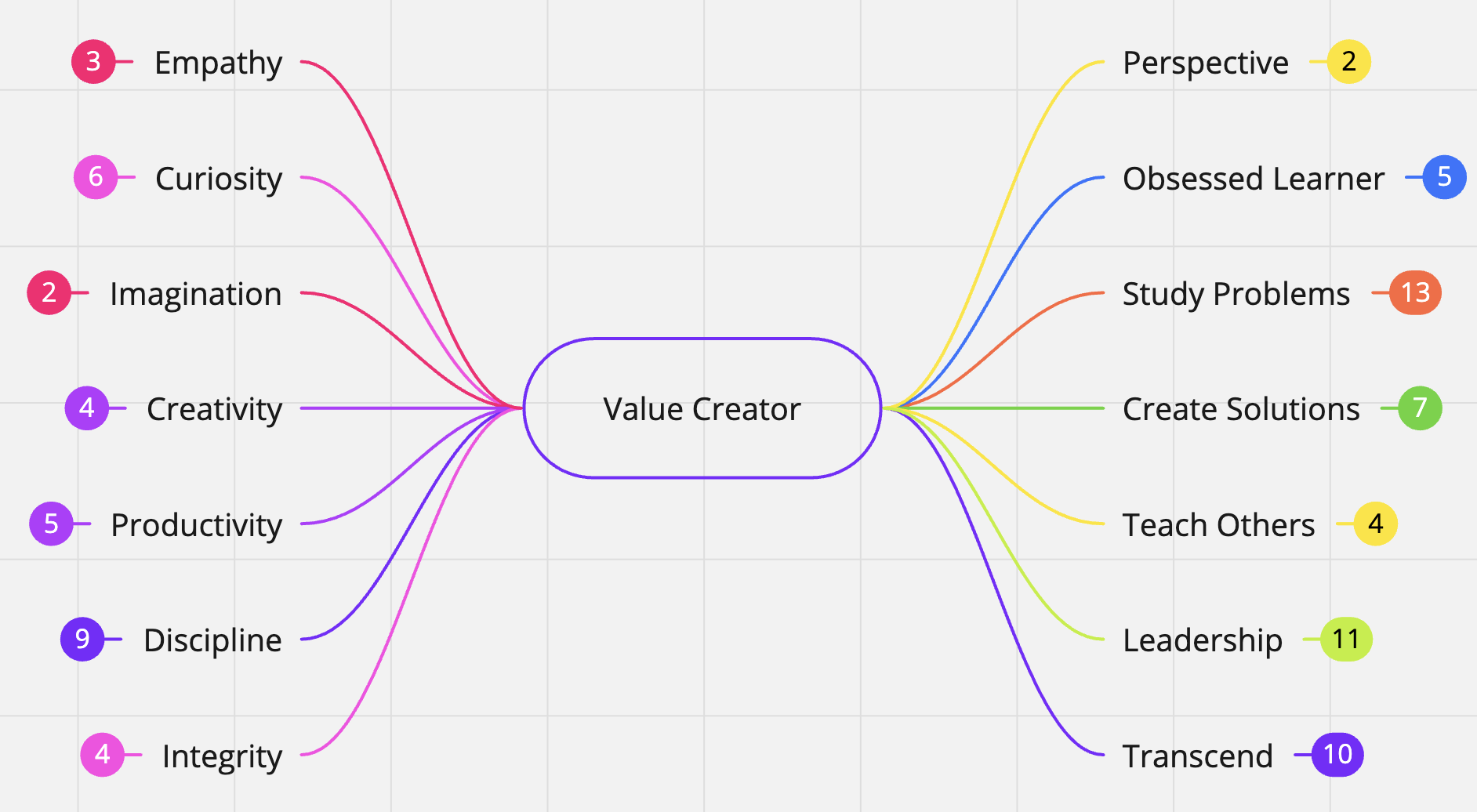
Inputs of a Value Creator:
Empathy
Being a value creator, starts with empathy, which is the ability to care for others well being. You see, if you don't truly care, you can't help people. They will realize it right away, when interacting with you. It has often been said, but is very true: people don't care what you know, until they know you care.
So, what do you need to care about? You need to care about other peoples success and helping them overcome their problems. You see, all business can be distilled down to this: you help enough people solve their problems, and they will help you solve yours. I wan't to be clear, the reciprocal nature of this principle, is a gift. You should not go into a relationship, looking for a reward. No, you show up, you help a situation, with no expectations. Try this, repeatedly, and you will be amazed what happens.
If you find yourself, lacking empathy, consider the following:
Listen Actively: Pay close attention when others are speaking. Don't just wait for your turn to talk; hear what they're really saying.
Ask Questions: Show interest in other people's experiences and feelings by asking them thoughtful questions.
Put Yourself in Their Shoes: Imagine how you would feel if you were in the same situation as the person you're trying to understand.
Be Open-Minded: Accept that people have different backgrounds and perspectives. Try not to judge them based on your own experiences.
Practice Patience: Sometimes it takes time to connect with someone else's feelings or point of view.
Read Fiction: Stories can help you understand different lives and emotions.
Watch Diverse Films and Shows: Like reading, watching characters in different situations can build empathy.
Volunteer: Helping others can give you a better sense of their lives and struggles.
Reflect on Your Feelings: Think about times you've felt similar emotions and how you dealt with them.
Learn from Others: Talk to people who you think are empathetic and ask for their advice.
Avoid Interrupting: Let others express themselves fully before you respond.
Show Compassion: Be kind and supportive when someone is going through a tough time.
Practice Mindfulness: Being aware of your own thoughts and feelings can help you understand others better.
Don't Make Assumptions: Just because you think you know how someone feels doesn't mean you do. Always check in with them.
Work on Your Nonverbal Communication: Pay attention to body language, eye contact, and facial expressions – both yours and others'.
Eventually, you will learn to love people and love solving their problems. That’s right, care leads to love, not a superficial sort of love, but a deep and genuine love for others and their problems, that you are uniquely equipped to help them solve. Now, at this point, you may be thinking, I am not equipped to help them solve their problems. Stay with me, we will discuss this later, but for now, realize, if you are reading this, you are more equipped than you may realize.
Curiosity
Curiosity is the next attribute of a value creator. Curiosity is the seeking of knowledge and pursuing interest that lead to your own self fulfillment. There is a Japanese principle, called, IKIGAI, which loosely translated, means, living a fulfilling life. How do you find, the fulfilling life? By following curiosity, to the center of several overlapping concepts of the following Venn diagram:
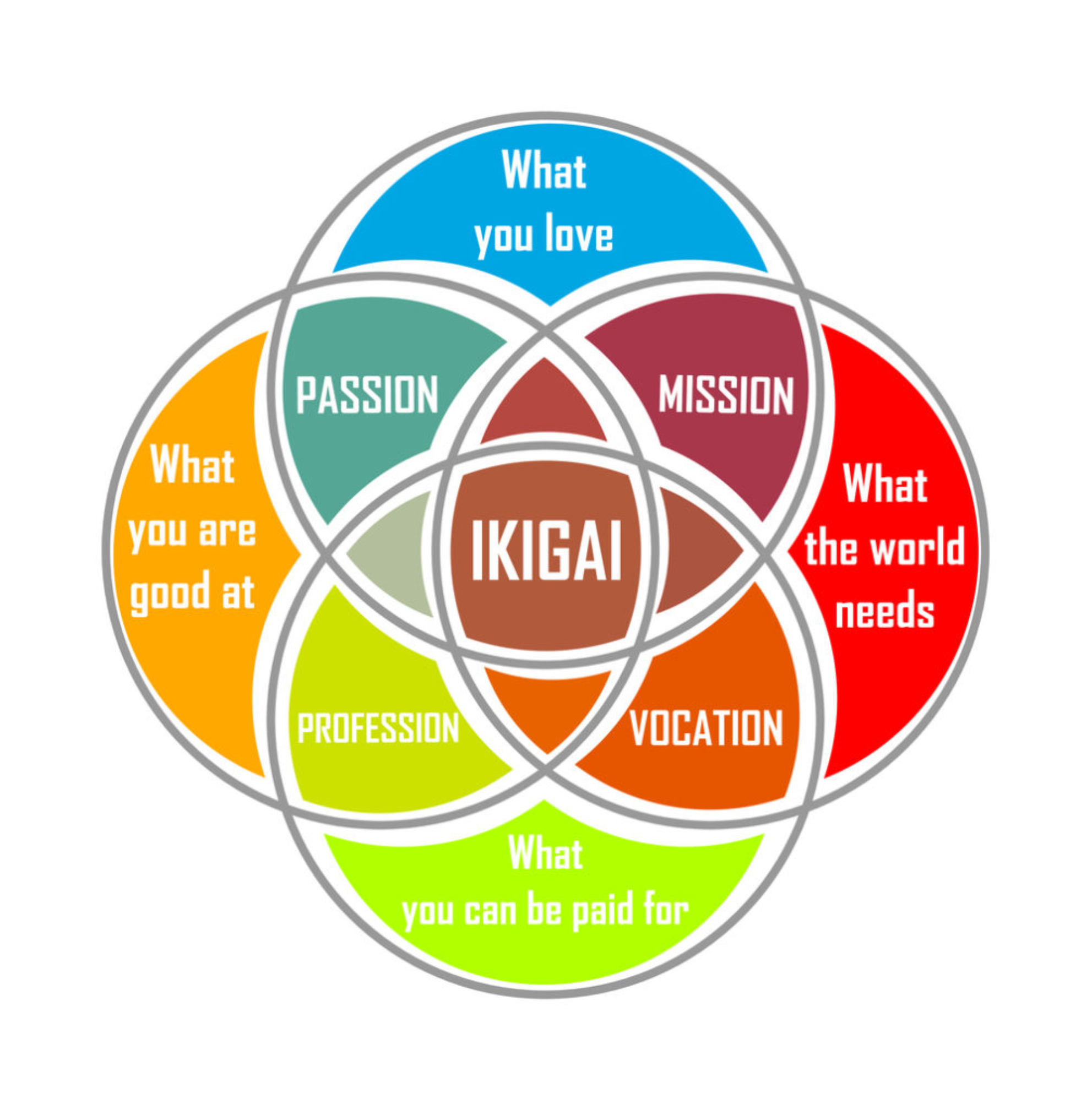
As can be seen above, IKIGAI involves finding balance and fulfillment by intersecting what you love, what you are good at, what the world needs, and what you can be paid for. When these elements come together, they create a sense of purpose and satisfaction, which is referred to as IKIGAI.
When discussing self fulfillment, it is useful to understand Maslow's hierarchy of needs.
Maslow's hierarchy of needs is a theory that says people have different levels of needs. As shown below, these needs start with basic things like food and water, then move up to safety, love, esteem, and finally self-actualization. People must fulfill lower-level needs before moving on to higher ones.
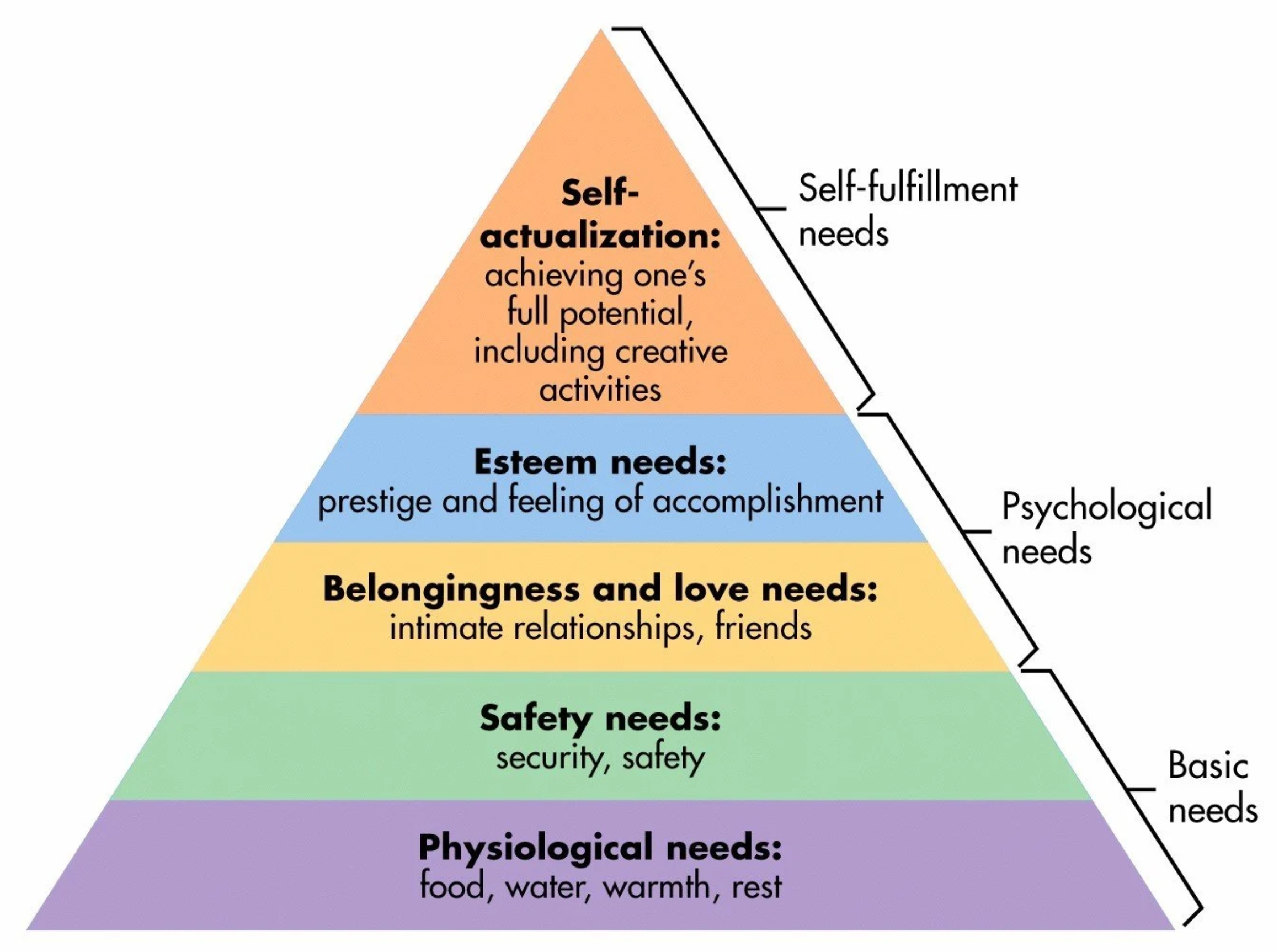
So, it is hard to be a value creator, if you are focused on your basic needs. No matter how hard you try to provide true values in others, if you are worried about where your next meal is coming from or your personal safety, you need to focus on those first. Then, when your basic needs are met, you can start to provide value in your personal relationships, and start to build up your confidence, as part of your psychological needs.
Now, when you have your basic and psychological needs met, you can direct your energy in self-actualization and self-fulfillment. I added this, because if you are pursuing your curiosity and trying to make progress toward self-fulfillment, before you address your basic and psychological needs, and you are struggling, this may be the reason.
There is another potential hindrance, concerning curiosity, that I want to address here, it is your focus or attention. How do you spend your time, particularly when online? Are you a consumer or a creator? We will talk more about this in the Discipline section, but at this point, I want you to start thinking in terms of becoming a creator more than a consumer. As you pursue your curiosity toward your IKIGAI, you will need to make a shift toward creating, over consuming, or you will get stuck, mindlessly consuming all day. Social media is particularly dangerous for this topic.
Top ways to cultivate your curiosity:
Curiosity is like a muscle; the more you use it, the stronger it gets. To keep your curiosity alive and thriving, consider these top strategies:
Ask Questions: Never stop asking questions about the world around you. Whether it's a "How does this work?" or a "What would happen if...?", every question propels you further on the path of knowledge.
Read Widely: Dive into books, articles, and blogs on topics both familiar and foreign to you. This broadens your understanding and exposes you to new ideas and perspectives.
Learn Continuously: Take up courses, attend workshops, or watch educational videos. Learning shouldn't stop at school—it's a lifelong journey.
Travel: If possible, explore new places. Traveling not only offers you a change of scenery but also immerses you in different cultures and ways of life.
Listen Actively: When conversing with others, truly listen to what they have to say. Everyone has a story that can offer you insights and spark your interest.
Explore Creativity: Engage in creative activities such as drawing, writing, or playing music. Creativity fuels curiosity by encouraging you to express and challenge yourself in new ways.
Stay Open-Minded: Be willing to challenge your own beliefs and consider alternative viewpoints. An open mind is a fertile ground for curiosity to grow.
Remember, cultivating curiosity is about embracing the unknown and the joy of discovering new things. Keep your sense of wonder alive, and let it guide you through an enriching and fulfilling life.
Imagination
Imagination is like a superpower everyone has. It lets you think up new ideas and see pictures in your mind of things that aren't really there. With imagination, you can come up with stories, solve problems in cool ways, or even invent something no one has ever seen before.
Think about when you read a book. The words on the pages help your imagination create the whole world inside your head. You can imagine what the characters look like, the places they go, and the adventures they have. That's all thanks to your imagination!
Also, when you play games, your imagination kicks in. Ever pretend to be a knight fighting dragons or an astronaut exploring space? That's you using your imagination to turn your backyard into a whole different universe.
Imagination isn't just for fun and games, though. Scientists and inventors use their imagination to think up new experiments or gadgets. Artists imagine beautiful paintings or sculptures before they make them real. Even adults use imagination at work when they think of new ways to do things or solve tricky problems. Interestingly, the imagination, happens in your sub-conscious. It often engages, when you are not directly thinking or doing a task. So, if you are stuck, take a break, do something else, or relax, and let the idea come to you!
You will need imagination, to solve others problems, by creating new ideas and thoughts that may help them. You will often go through process of working with your boss or client to perform: Ideation, Critical Thinking, Brainstorming, Whiteboarding. When collaborating with others, this super power is particularly important.
Here are 5 ways to supercharge your imagination:
Read Widely: Dive into books on various topics. Reading expands your mind and exposes you to new concepts, cultures, and ideas.
Ask Questions: Don't just accept things as they are. Ask why and how. Dig deeper to understand the world around you.
Play: Yes, play! Games, puzzles, and creative activities stimulate your brain and can lead to innovative thinking.
Daydream: Take time to let your mind wander. Daydreaming can be a source of creative breakthroughs.
Relax: do something else, and let your subconscious engage and solve the problem for you.
Collaborate: Share your ideas with others and listen to theirs. Collaboration often leads to inspiration.
Foster your imagination, grow it, harness it. Never stop using your imagination. It's a special part of who you are, as a value creator, and it can take you anywhere!
Creativity
I intentionally broke out creativity from imagination. You can be imaginative, but not creative. There is a difference.
Creativity is taking your imagination and making it real. It is the active part of creation. It's about turning those cool ideas into something you can see, touch, or use. When you're creative, you find new ways to do things and bring fresh ideas to life.
For example, think about building a fort out of blankets and chairs. Your imagination helps you dream up the fort, but creativity is what gets you to gather materials and figure out how to put them all together. That's when your idea becomes something you can actually play in.
In the world of work, creativity is super important. It's not just for artists or musicians. Everyone can be creative in their own way. Whether you're coming up with a clever solution to a problem at work, designing a new app, or finding a faster way to organize data, that's all creativity in action.
Here are some ways to boost your creativity ( you will notice some overlap with imagination, which is intentional):
Try new things: Doing the same stuff all the time can make your brain bored. Mix it up! Learn a new skill, read different kinds of books, or travel to new places.
Ask questions: Don't just accept things as they are. Ask why, how, or what if. Questions can lead to amazing discoveries.
Collaborate with others: Two heads are often better than one. Working with other people can spark ideas you might not have had on your own.
Take breaks: Sometimes stepping away from a problem can help your brain come up with creative solutions. Go for a walk, play a game, or take a nap.
Don't fear failure: Not every idea will be a winner, and that's okay. Each mistake is a chance to learn and get better.
Productivity
Productivity is the ability to stay on task and produce value, over long periods of time. This does not mean, continuous activity, but it does mean consistent completion of value creating projects, over time. Productivity is interesting, in that it is assessed by another person, not yourself. You see, you are producing something for someone else, and what matters is their assessment of your productivity. Whether your peers, you boss, or your client, they will assess your productivity.
As a value creator, you want to be known for your productivity. Now, you learn to work smarter, not harder, and automate when you can, so the end result is the same, high quality valuable deliverable of projects, for others.
Ideas to help you improve your productivity:
Set Clear Goals: Start by defining what you want to achieve. Break down your main objectives into smaller, manageable tasks.
Prioritize Wisely: Focus on the most important tasks first. Use a system like the Eisenhower Box to decide on and prioritize tasks by urgency and importance.
Limit Multitasking: Studies show that multitasking can actually make us less efficient. Try to concentrate on one task at a time and you'll find your productivity levels shooting up.
Use Technology to Your Advantage: There are plenty of apps and tools designed to help you stay organized and manage your time better. Tools like Asana or Trello can help keep your projects on track.
Take Regular Breaks: It might seem counterintuitive, but taking scheduled breaks can actually help improve concentration. Short breaks after 90-minute work periods are considered very effective.
Eliminate Distractions: Identify what commonly distracts you in your work and find a way to minimize it. If you're constantly checking your phone, turn off notifications during work hours.
Set a Timer: The Pomodoro Technique encourages people to work with the time they have—rather than against it. Work for 25 minutes, then take a five-minute break.
Keep a Clean Workspace: A tidy workspace can help keep a clear mind. Take a few minutes at the end of each day to clean and organize your workspace.
Stay Healthy: Never underestimate the power of sleep, exercise, and good nutrition on your productivity. They have direct impacts on your energy levels and focus.
Reflect on Your Productivity: At the end of each day, take time to reflect on what you accomplished and what could be improved. This will help you plan more effectively for the next day.
Discipline
Discipline is like the secret ingredient that turns your empathy, curiosity, imagination, creativity, and productivity into real value. It's about doing the work, even when it's tough, boring, or you just don't feel like it.
Without discipline, ideas stay as daydreams, and problems don't get solved, and you are not productive. But with discipline, you can keep pushing forward, learning more, and getting better at whatever you do.
Discipline is going to be required, to switch from being a consumer of online content, to a value creator. We all are given a set amount of time in day, a week, a year. The question is, where do you spend your time?
To illustrate this point, think about it, if your daily routine looked like this, over 24 hours:
8 hours sleep
10 hours work + commute
2 hours of eating + self care (bathroom, fitness, relaxing)
4 hours of what?
Then, what about your weekends? In order to reach your IKIGAI, you will need to do the hard things, that others won't do. You may need to give up TV, or netflix, or video games, or even social media, in order to accomplish your goals.
It has been said and is largely agreed, that it will take 10,000 hours to become an expert at anything. Whether a doctor, a pilot, a policeman, a cybersecurity expert, that is generally true. Now, it will also take you about 300-500 hours of study to learn a new topic enough to enter a field. So, how long will it take you to get those 300-500 hours? Well, using the above schedule, if you used 2 hours a day, it would take you about 150-250 days or 5-7 months of disciplined hard work. If you used all 4 of your “extra” hours in a day, you could cut that time in half.
Then, after you land that first job, that is just the start. If you want to excel in the field, you need to get those 10,000 hours in. Now, how long will that take you? It depends on your level of discipline. If you don't do anything but work 8 hours a day, this will take you about 5-6 years to become an expert. However, if you have discipline and can keep putting in those 2-4 hours a day, you can slice this time in half and consider yourself an expert in 3 years. That is the power of discipline.
This is a secret of my success, many of my 10,000 hours came at night, between the hours of 10pm and 2am. After the kids are in bed, after all other things are done. If you are more of a morning person, perhaps you need to start getting up 2-4 hours earlier than everyone else? Either way, that is a great time to get your reps in and accelerate your growth toward being a value creator.
Here are some tips to help you build discipline:
Take inventory of your time: and ask yourself, do you want to do this the easy way or the hard way, the short way or the long way? Then, make changes.
Set clear goals: Know what you want to achieve. This gives you something to aim for.
Make a plan: Break your big goals into smaller steps. Then tackle each step one by one.
Schedule your task done: block out your schedule to include learning time, or someone else will take those slots.
Stick to a routine: Having a regular schedule can help you stay on track.
Stay organized: Keep your workspace tidy and your tasks in order. A cluttered space can lead to a cluttered mind.
Reward yourself: Celebrate your successes, no matter how small. Rewards can motivate you to keep going.
Integrity
I intentionally saved the most important input attribute of a value creator, to last. Integrity is doing the right thing, even when no one else is watching. You can mess up a lot of things on the input side of being a value creator, but don't mess up your integrity.
Integrity is important in building trust in others. Trust is a key element of any relationship and particularly one where value is to be created. You will have a reputation, no matter if you like it or not. Your reputation is built in large part due to your work ethic and integrity. So guard your integrity and reputation: you only get one chance at a first impression.
Ethics are closely related to Integrity. Ethics matter, a lot in the field of cybersecurity. I mean, ethics should always matter, but in fields where others lives may be on the line, as in the case of protecting critical infrastructure, ethics is crucial. Ethics comes into play, when there is no direct law prohibiting an activity. So, when there is a gray area, and no clarity if an activity is legal or not, each person relies on their sense of ethics to regulate their behavior.
The problem with ethics, is that each person has a different moral compass and sense of "right" or "wrong", based on their up-bringing, their culture, their religious views, etc. For example, for me personally, I derive my system of ethics, from my faith, in Christ. It guides all aspects of my life, including ethics.
That said, I can assure you that in some places in the world, their view of ethics is different than yours. It is all a matter of perspective. However, if after much reflection, you think you may have a poor sense of ethics, I suggest you reform your system of ethics around potential harm to others. This is like the doctors hippocratic oath. Simply put, if the actions are legal but you question if you should do them, ask yourself if anyone at all may be harmed by your actions, then don't do them.
For example, if you were hired to assess a companies network and you see sensitive information, that may be useful for your own gain, at the expense of the client, would you copy it, or even read it? Clearly, they hired you to assess them, so reading it is not illegal, but copying it likely is. So, would you read it and use it? That is where your ethics comes into play. Someone would be harmed in that situation, so don't do it.
Here is another scenario. During part of a security research project, you find a critical vulnerability, in a widely used software application and you have a choice, to make. There is a security conference in 60 days, and the deadline for papers is next week, would you take the opportunity to potentially advance reputation as an advanced hacker and present the information publicly? Or would you forego that short term notoriety and instead reach out to the software vendor to disclose the vulnerability and give them a reasonable amount of time to fix it, before disclosing it to the public. Again, in this scenario, if you take the information public, before there is a fix, others may be harmed, so don't do it.
If you work long enough in this field, you will come across this dilemma, perhaps many times. My point in describing these simple scenarios, is that these types of situations come up all the time in Cybersecurity and you better determine up front, how you will act, or you may fail the test, when the time comes.
Value creators, exhibit the highest levels of all these input attributes, particularly Integrity.
This was part one of two, in this series. Stay tuned for the next part. Until then, get involved in my skool community.
Jump in, ask questions, start to provide value to others, and practice those skills.
This is part 1 of a 2 part series, see part 2 here.
Allen
